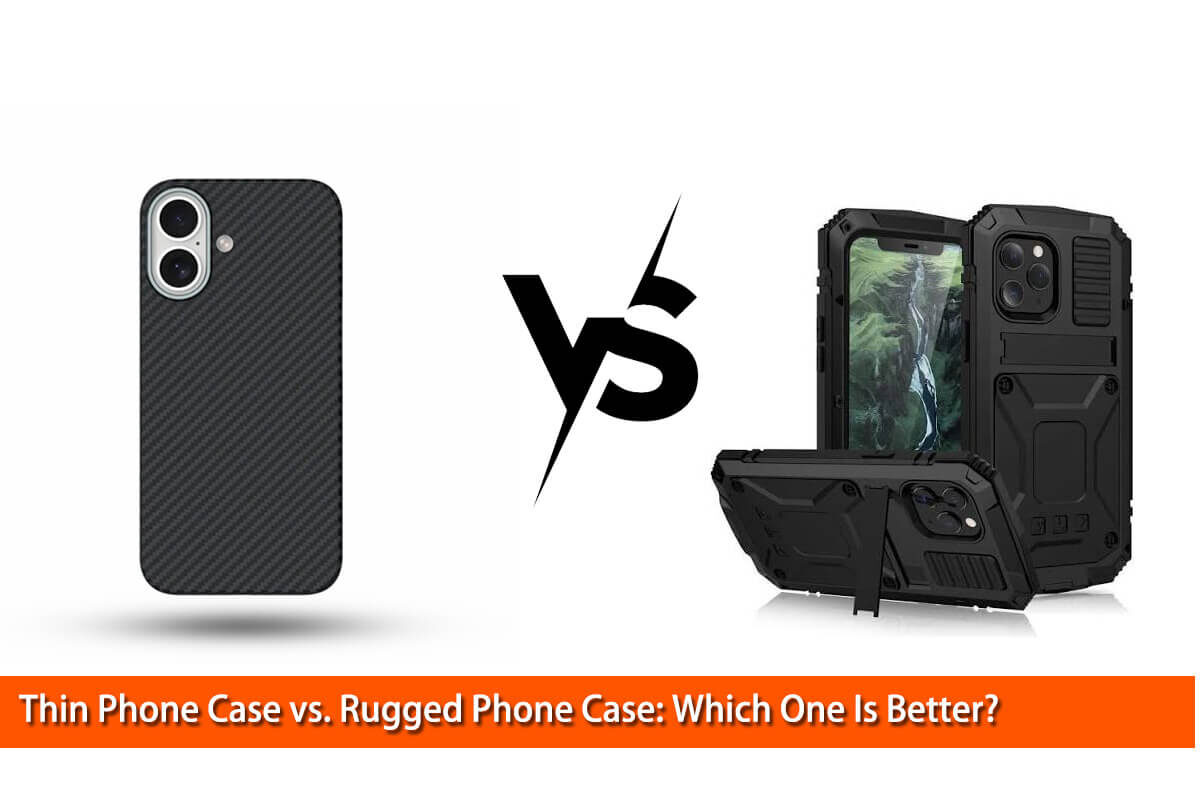
Choosing a phone case sounds simple until you start comparing hundreds of designs. Some cases are barely thicker than the phone itself, while others add substantial protection around every edge and corner. So which is actually better: a thin phone case or a rugged phone case?
As a materials engineer, I would not answer this simply by saying, “Rugged cases protect better.” The engineering is more interesting than that.
A phone case is a small protective structure. Its performance depends on material properties, geometry, fit, impact absorption, corner design, surface grip, and how the case is actually used. A thick case can be poorly designed, while a carefully engineered thin case can provide meaningful everyday protection.
Consumer Reports makes a similar point in its phone-case research: a bulky case does not automatically provide better protection, and a well-fitting slim case can be effective when it has features such as raised edges and protected corners.
So, instead of asking which type is universally better, let’s look at what each design is actually engineered to do.
Thin Phone Case vs Rugged Phone Case: At a Glance
| Feature | Thin Phone Case | Rugged Phone Case |
|---|---|---|
| Thickness | Very low | High |
| Weight | Lightweight | Heavier |
| Pocket comfort | Excellent | Moderate |
| Original phone feel | Preserved | More altered |
| Scratch protection | Good | Excellent |
| Minor drop protection | Good, depending on design | Excellent |
| Extreme-impact protection | More limited | Generally better suited |
| Corner protection | Depends on design | Usually reinforced |
| Grip | Material dependent | Usually strong |
| Outdoor use | Moderate | Excellent |
| Minimalist appearance | Excellent | Limited |
| MagSafe usability | Usually convenient | Depends on construction |
The important point is that these categories describe design priorities, not guaranteed performance.
What Is a Thin Phone Case?
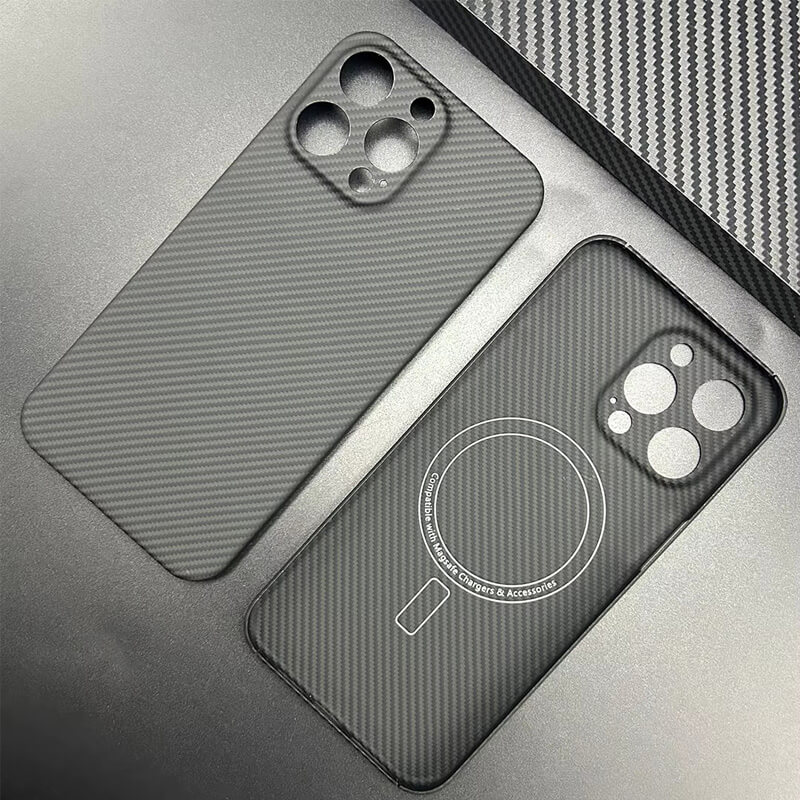
A thin phone case is designed to add protection while keeping the phone as close as possible to its original size and weight.
Instead of surrounding the phone with thick layers of cushioning, designers typically use a relatively small amount of material and rely on precise fit, structural stiffness, surface protection, and carefully positioned protective features.
Common materials include:
- TPU
- Polycarbonate
- Silicone
- Aramid fiber
- Carbon-fiber composites
- Hybrid material constructions
A thin case can be particularly useful for people who mainly use their phones at home, in an office, while commuting, or in other relatively controlled environments.
Its biggest advantage is simple: you still feel like you’re using the phone rather than a phone inside a large protective shell.
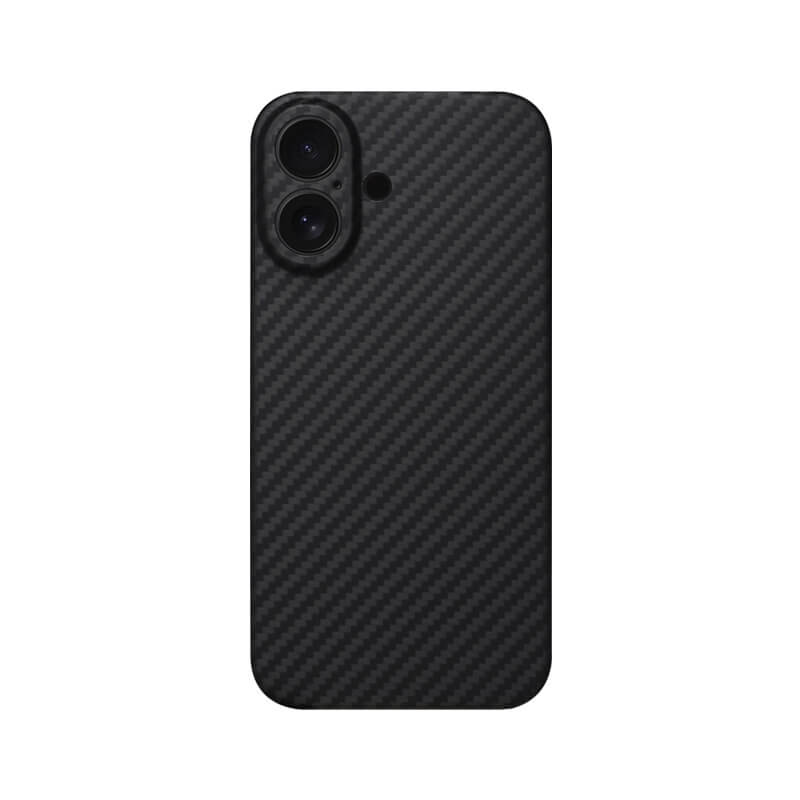
Strong MagSafe magnets ensure secure attachment.
Slim profile protects without adding unnecessary bulk.
Raised edges protect screen and camera.
Textured surface provides a secure grip.
Precise cutouts ensure easy everyday access.
Durable construction helps absorb everyday impacts.
Supports wireless charging without removing the case.

What Is a Rugged Phone Case?
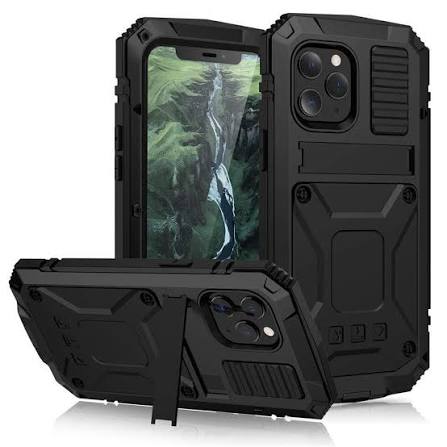
A rugged phone case takes a different engineering approach.
Instead of minimizing material, it gives the designer more physical space to incorporate:
- Thicker protective walls
- Reinforced corners
- Flexible shock-absorbing layers
- Rigid outer shells
- Raised screen bezels
- Raised camera bezels
- Textured grip surfaces
- Multi-layer construction
That extra material can be valuable when the phone experiences repeated or higher-energy impacts.
For example, someone working on a construction site, hiking on rocky terrain, or regularly using a phone around machinery faces a different risk profile from someone whose phone spends most of its day on an office desk.
Consumer Reports’ 2026 guidance makes essentially this distinction: people who hike or work in construction may have good reasons to choose heavier-duty protection, while users in ordinary daily environments can reasonably consider slimmer cases.
Why Does a Rugged Case Usually Provide More Drop Protection?
When a smartphone hits the ground, its problem is not simply that it experiences a “hard hit.”
The phone has kinetic energy that must go somewhere.
A protective case attempts to manage that energy by:
- Deforming during impact.
- Absorbing some of the impact energy.
- Spreading forces over a larger area.
- Protecting vulnerable corners and edges.
- Increasing the time over which the phone decelerates.
That last point is especially important.
Imagine stopping a moving object almost instantly versus slowing it down over a slightly longer period. The second situation can reduce the peak force experienced by the object.
This is one reason flexible polymers such as TPU are frequently used in protective case construction. They can deform under impact rather than behaving like a completely rigid shell.
But there is an important engineering principle here:
More material does not automatically mean better protection.
A case needs to be designed correctly.
Why Phone Case Corners Matter So Much
If you have ever seen a phone survive a drop onto its back but crack after landing on one corner, you have seen this principle in practice.
Corners are vulnerable because the impact area is relatively small. That can concentrate forces into a limited region of the phone.
A well-designed case therefore often provides additional protection around the corners.
Consumer Reports specifically recommends looking for padded corners and designs that create additional separation or an “air gap” between the phone and the outside of the case. It also recommends raised edges around both the screen and camera.
This is why, when comparing two cases, I would pay more attention to corner geometry and fit than simply comparing their thickness.
Materials Matter More Than Case Thickness
From a materials-engineering perspective, “thin” and “rugged” are not material categories.
A thin case can use an advanced structural material, while a thick case can use inexpensive plastic. Their performance can therefore be very different.
TPU
Thermoplastic polyurethane is flexible and commonly used where cushioning and impact absorption are important.
Its flexibility can also help a case grip the phone securely.
Polycarbonate
Polycarbonate is much more rigid than TPU and is useful when a manufacturer wants structural support without using extremely thick walls.
This is why many protective cases combine rigid and flexible materials.
Hybrid Construction
A common engineering strategy is:
Flexible inner layer + rigid outer layer
The flexible material helps with cushioning and fit, while the rigid layer contributes structural support.
This is one reason a relatively slim hybrid case can provide considerably more protection than its appearance might suggest.
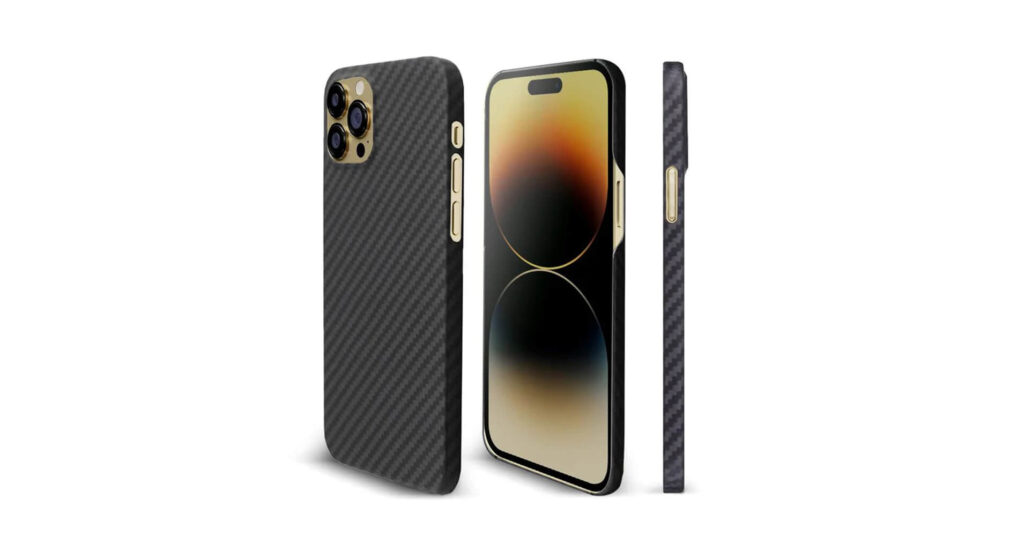
Where Does a Carbon Fiber Phone Case Fit?
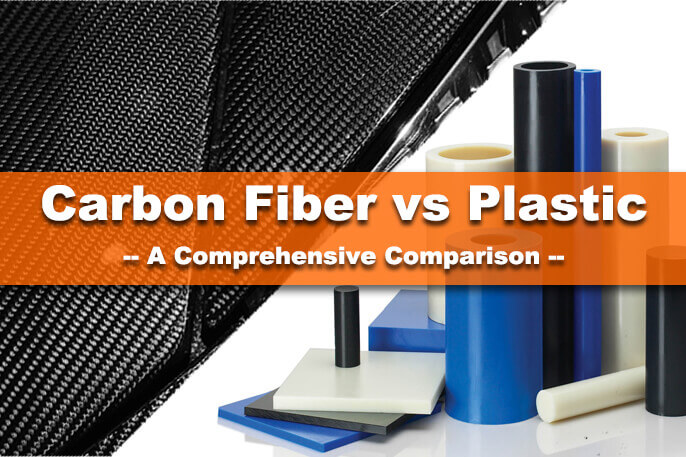
Carbon fiber is particularly interesting because it approaches the thin-versus-rugged problem from another direction.
Carbon fiber reinforced polymer (CFRP) is widely used in aerospace, motorsports, sporting equipment, and other applications where high stiffness and strength are needed without excessive weight.
A scientific review published in Composites Part A describes carbon fiber as an important reinforcement because of its high strength and modulus and explains how fiber structure and processing influence its final mechanical performance.
Another review notes that CFRP’s major attraction is its high specific strength and specific stiffness—in other words, useful mechanical performance relative to its weight.
That property makes carbon fiber attractive for thin phone cases.
Instead of simply adding more material, an engineer can use a stiff, lightweight composite structure to create a case that adds relatively little bulk.
However, there is an important distinction:
Carbon fiber is not automatically a shock-absorbing material simply because it is strong.
Carbon fiber is very stiff. A phone case still needs appropriate geometry, resin, edge design, mounting, and—depending on the product—a combination of materials to manage impacts effectively.
This is an important difference between material strength and complete product performance.
The scientific literature also shows that the final properties of carbon-fiber composites depend on fiber arrangement, matrix material, interfaces, manufacturing process, and loading conditions.
So when evaluating a carbon fiber phone case, don’t look only at the words “carbon fiber.” Look at how the material is actually engineered into the case.
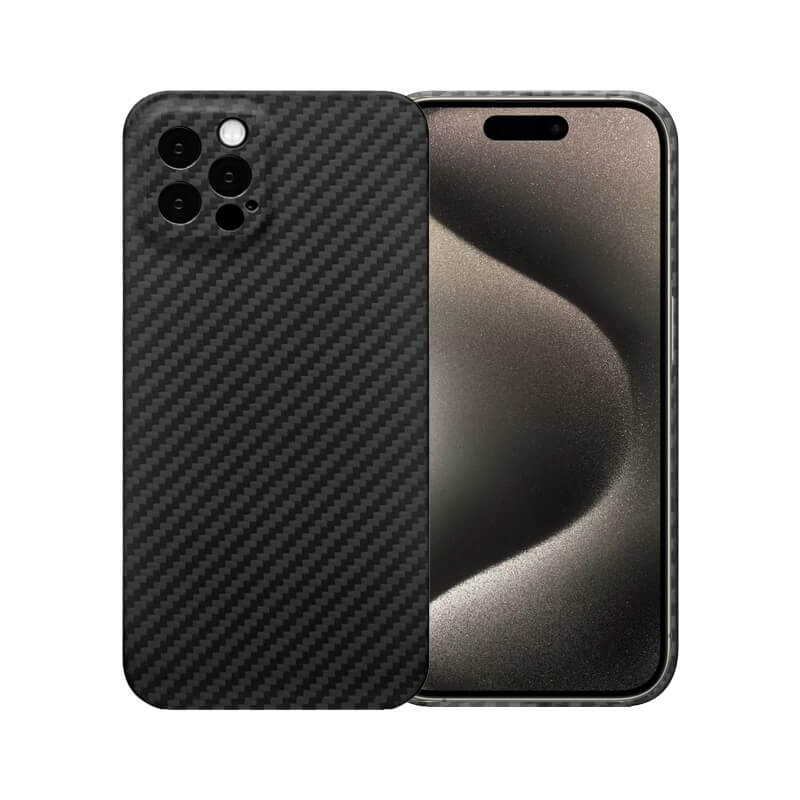
A premium, lightweight, and performance-inspired look.
Slim design, protects your iPhone without adding unnecessary bulk.
Built-in MagSafe magnets support convenient charging and accessories.
Precision fit provides easy access to buttons, ports, and cameras.
Raised edges help protect your screen and camera lenses from scratches.
Designed specifically for the iPhone 15 Pro for a precise fit.
Thin vs. Rugged: What About Grip?
There is another form of phone protection that is easy to overlook:
preventing the phone from falling in the first place.
A very slippery case can increase the chance of an accident.
Surface texture, material friction, side-wall design, and hand feel therefore matter.
Consumer Reports specifically recommends considering grip, particularly because modern smartphones often combine glass backs with smooth metal edges.
A thin case with a good textured surface can therefore have an important practical advantage.
For everyday use, I would consider:
- Does it slip when your hands are dry?
- Is it comfortable during long periods of use?
- Can you grip it securely with one hand?
- Does the material become slippery when wet?
- Are the sides easy to hold?
A case that prevents some drops may provide more practical protection than a much thicker case that you frequently struggle to hold.
Screen and Camera Protection Should Not Be Ignored
Drop protection is not only about the back and corners.
Two other areas deserve attention: the display and camera lenses.
A good case should ideally provide:
Raised screen edges
If the phone lands face-down on a reasonably flat surface, a raised bezel can help prevent the glass from making direct contact.
Raised camera edges
Modern smartphone cameras can protrude significantly from the back of the phone. A raised camera bezel can help keep the lenses away from surfaces.
Precise fit
The case should fit the exact phone model securely without excessive movement.
Consumer Reports’ current recommendations specifically emphasize precise fit and raised protection around both the front display and rear camera.
What About “Military-Grade” Phone Cases?
This is an area where consumers should be particularly careful.
You may see cases advertised as:
“Military grade.”
That phrase sounds impressive, but it does not tell you enough by itself.
MIL-STD-810 is a broad U.S. Department of Defense environmental engineering standard. It covers different environmental stresses and test methods rather than providing one universal “phone case toughness score.” The official U.S. Defense Logistics Agency describes MIL-STD-810 as a framework for considering environmental stresses and emphasizes that it does not simply impose one fixed design specification for every product.
Different shock and drop procedures can involve different conditions, equipment, orientations, and acceptance criteria.
Therefore, if a case manufacturer says it passed a military standard, ask:
- Which version?
- Which method?
- Which procedure?
- What drop height?
- How many drops?
- What surface?
- Which phone was tested?
- Was the case tested with the actual phone inside?
- What happened after testing?
The standard itself is much more informative than the marketing phrase.
Thin or Rugged: Which One Should You Choose?
There is no universal answer.
A thin phone case may make more sense if you:
- Rarely drop your phone
- Mainly use it at home or in an office
- Carry it in a pocket frequently
- Prefer a lightweight device
- Want to preserve the original phone design
- Use MagSafe accessories regularly
- Prefer minimalist aesthetics
A rugged phone case may make more sense if you:
- Frequently drop your phone
- Work outdoors
- Work in construction or industrial environments
- Hike or travel in demanding conditions
- Need maximum corner protection
- Regularly expose your phone to hard surfaces
A slim protective case may be the middle ground if you:
- Want meaningful everyday protection
- Don’t want excessive bulk
- Care about weight
- Want stronger structural materials
- Prefer an advanced material such as carbon fiber
This is where a well-designed carbon fiber phone case can be an interesting option for users who value low weight and stiffness while still wanting protection from everyday wear and impacts.
How to Choose a Phone Case Like an Engineer
Before buying, don’t simply ask, “How thick is it?”
Ask these questions instead:
1. How well does it fit my exact phone?
A loose case can compromise protection.
2. Are the corners reinforced?
Corners are critical impact zones.
3. Is the screen bezel raised?
This provides separation between the display and a surface.
4. Is the camera bezel raised?
The camera module needs protection too.
5. What materials are used?
Understand whether you’re buying TPU, PC, carbon fiber composite, or a hybrid construction.
6. How much weight does it add?
Protection should be considered together with usability.
7. How good is the grip?
Reducing accidental drops is valuable protection.
8. Does it support MagSafe and wireless charging?
Especially important for modern iPhones.
9. Are protection claims supported by actual testing?
Look for test conditions rather than vague marketing language.
10. Does the design match your environment?
This may be the most important question of all.
Final Verdict: Thin or Rugged?
The thin-versus-rugged debate is ultimately a question of risk versus usability.
A rugged case gives designers more room for cushioning, reinforced corners, raised edges, and additional protective structures. It can be particularly valuable when a phone is exposed to frequent or severe impacts.
A thin case, however, can offer excellent everyday usability and meaningful protection without turning a slim smartphone into a bulky device. As Consumer Reports’ testing and guidance demonstrate, thickness alone is not a reliable measure of case performance. Fit, corners, raised edges, grip, and construction all matter.
For users who want a balance between low weight, structural stiffness, premium materials, and minimal bulk, carbon fiber is particularly interesting. Carbon-fiber composites are used in demanding engineering applications precisely because they can deliver high specific strength and stiffness at relatively low weight.
The best phone case, therefore, is not necessarily the thickest one.
It is the case whose materials, structure, protection features, and usability match the way you actually use your phone.
References
- Consumer Reports — The Best Cell Phone Case for Your Pricey Device
- Consumer Reports — Best Phone Cases for Samsung Galaxy S26 Series
- U.S. Defense Logistics Agency — MIL-STD-810 Environmental Engineering Considerations and Laboratory Tests
- ScienceDirect — Processing, Structure, and Properties of Carbon Fibers
- ScienceDirect — The Fatigue of Carbon Fibre Reinforced Plastics: A Review
- ScienceDirect — Carbon Fibers Derived from Commodity Polymers: A Review