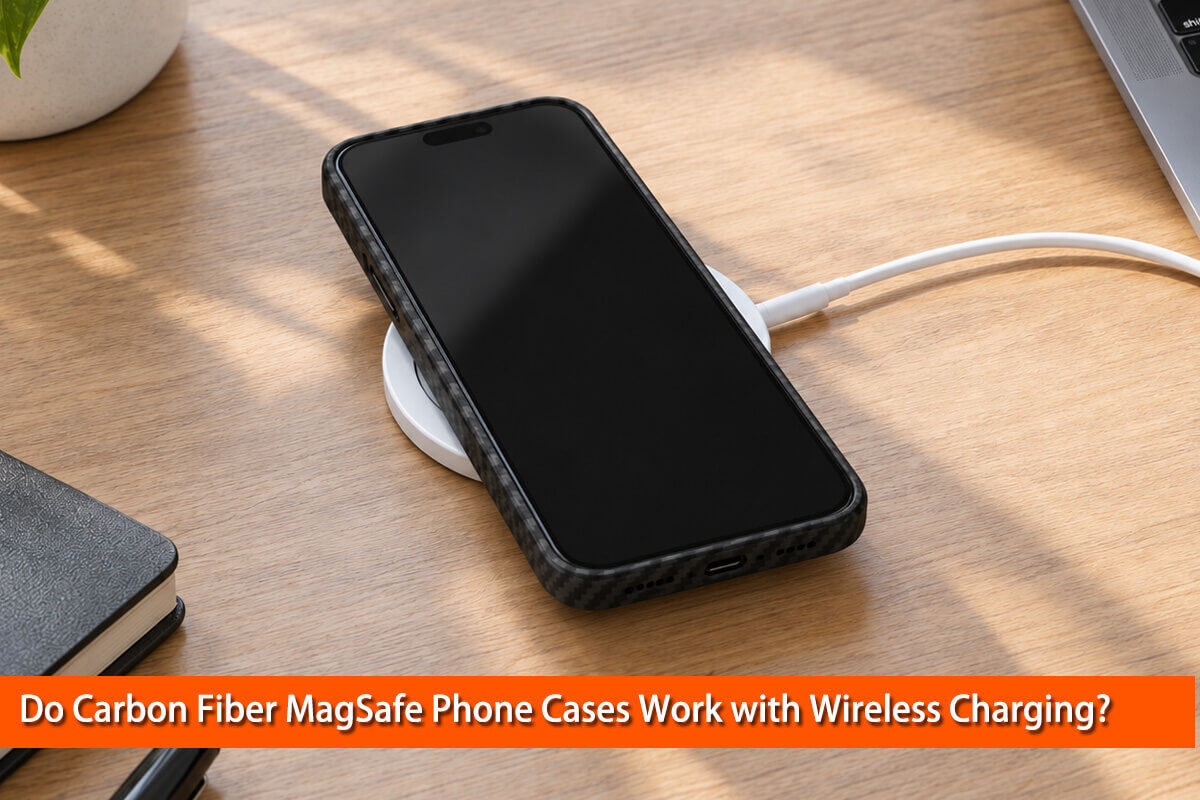
If you are considering a carbon fiber MagSafe phone case, one of the first questions you may have is simple: Can you still use wireless charging without removing the case?
In most cases, the answer is yes—if the case is specifically designed for MagSafe and wireless charging. However, the answer is not determined by the words “carbon fiber” alone.
As a carbon fiber materials engineer, I would look at the complete construction of the case: the type and arrangement of the carbon fiber, the case thickness, the magnetic ring, the materials around the charging area, and the distance between the phone’s charging coil and the charger.
This distinction matters because carbon fiber is electrically conductive. Research on carbon-fiber composites has repeatedly demonstrated that carbon fiber can provide electrical conductivity and electromagnetic-interference (EMI) shielding. That does not mean every carbon fiber phone case will stop wireless charging, but it does mean the material deserves more careful consideration than ordinary plastic.
So, let’s look at what actually happens when you put a carbon fiber MagSafe case between your iPhone and a wireless charger.
Quick Answer: Do Carbon Fiber MagSafe Cases Work with Wireless Charging?
Yes, a properly designed carbon fiber MagSafe case can work with wireless charging.
The important word is designed.
A well-engineered case should account for:
- The electrical properties of carbon fiber
- The thickness of the carbon-fiber composite
- The position of the phone’s charging coil
- The position and strength of the magnetic ring
- Other conductive or metallic components
- The distance between the phone and charger
- Heat generated during charging
Apple itself does not say that every case will work equally well. Its wireless-charging guidance says that thick, metal, or battery cases can cause slow charging or prevent charging, and recommends removing the case if this occurs. Apple also recommends placing the iPhone correctly in the center of the charger for best performance.
Therefore, the better question is not “Does carbon fiber block wireless charging?”
It is:
“Is this particular carbon fiber case engineered so that its materials and construction do not significantly interfere with wireless power transfer?”
That is the question that actually matters.
How Does Wireless Charging Work Through a Phone Case?
Wireless charging is based on a principle called electromagnetic induction.
Inside a wireless charger is a coil that creates an alternating magnetic field. Your phone contains another coil. When the two coils are positioned correctly, energy can be transferred from the charger to the phone without a physical electrical connection.
The phone then converts that transferred energy into electrical power for the battery.
Apple describes iPhone wireless charging as using magnetic induction and recommends keeping the phone properly aligned with the charger.
A phone case sits between these two systems.
That means the case is not electrically connected to either the charger or the phone. But its material, thickness, geometry, and position can still influence how efficiently energy is transferred.
Think of it this way:
Charger → magnetic field → phone case → phone charging coil
The case needs to allow that system to work efficiently.
A very thin, carefully designed case may have little practical effect. A thicker case containing conductive or metallic components in the wrong location can create a very different result.
What Does MagSafe Add to Wireless Charging?
MagSafe and wireless charging are closely related, but they are not exactly the same thing.
Wireless charging is the power-transfer system.
MagSafe adds a magnetic alignment and attachment system around that charging experience.
The magnets help position the charger correctly over the phone’s charging area. This is important because alignment between the transmitter and receiver coils affects charging performance.
Apple describes its MagSafe Charger as using precisely aligned magnets and currently states that its charger is certified for Qi2 25W and Qi charging.
This is why a genuine MagSafe-compatible case normally contains a precisely positioned magnetic ring.
The ring is not simply decorative.
It helps the charger attach to the correct location and maintain alignment while the phone is being charged.
Does Carbon Fiber Interfere with Wireless Charging?
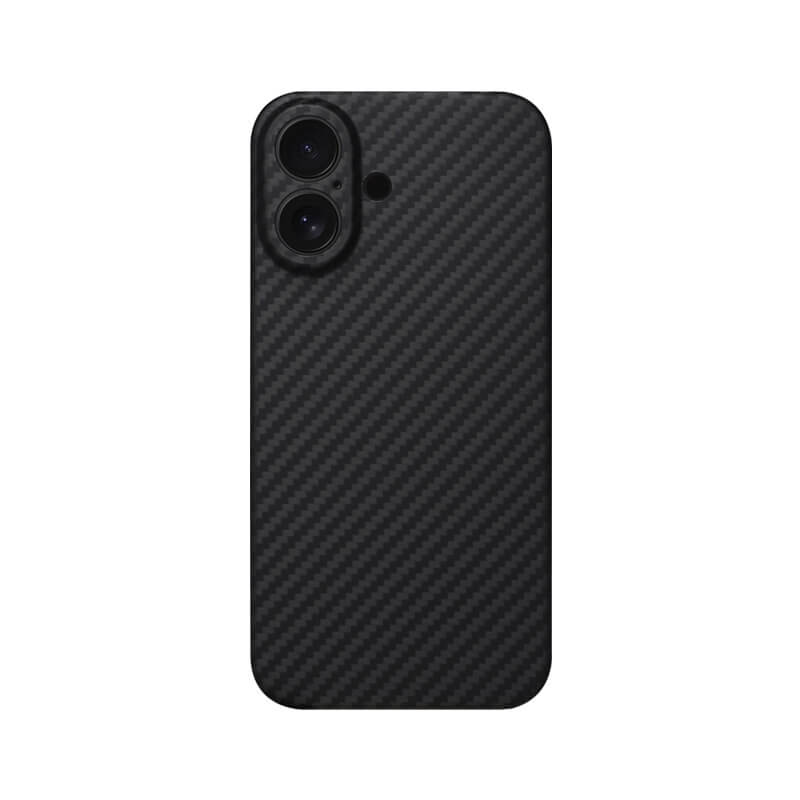
Strong MagSafe magnets ensure secure attachment.
Slim profile protects without adding unnecessary bulk.
Raised edges protect screen and camera.
Textured surface provides a secure grip.
Precise cutouts ensure easy everyday access.
Durable construction helps absorb everyday impacts.
Supports wireless charging without removing the case.

This is where the subject becomes more interesting from a materials-engineering perspective.
Carbon fiber is electrically conductive.
Peer-reviewed research has demonstrated electrical conductivity and electromagnetic-shielding behavior in carbon-fiber composites. The properties depend strongly on factors such as fiber content, orientation, connectivity, and composite structure.
This is very different from materials such as ordinary plastics, which are generally electrical insulators.
But there is an important point that is often missed online:
Conductive does not automatically mean “wireless charging will not work.”
The actual effect depends on the complete structure.
For example, researchers have shown that the electrical and electromagnetic behavior of carbon-fiber composites changes with fiber orientation, fiber content, layer structure, and other design factors.
A phone case is also much more complicated than a large laboratory shielding panel. It may use a very thin carbon-fiber laminate combined with resin, polymer, adhesive layers, a magnetic ring, protective edges, and other components.
Therefore, it is inaccurate to make a blanket statement such as:
“Carbon fiber blocks wireless charging.”
The more technically accurate statement is:
Carbon fiber is conductive, so its construction and placement should be considered when designing a wireless-charging-compatible case.
Why Do Some Carbon Fiber Cases Charge Normally?
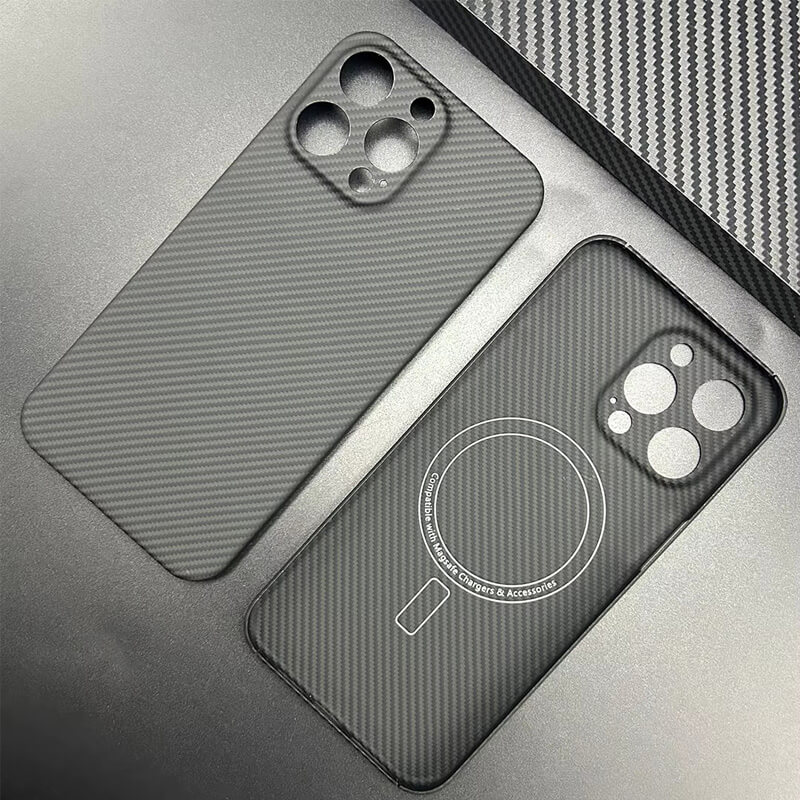
A well-designed carbon fiber case can be engineered around the wireless-charging system.
Several factors are particularly important.
1. Case thickness
The greater the distance between the phone’s charging coil and the charger’s coil, the more difficult it can be to maintain efficient power transfer.
This is one reason Apple specifically recommends removing a thick case if an iPhone charges slowly or fails to charge.
For a carbon fiber case, the goal is not simply to use as much carbon fiber as possible. The goal is to achieve the required mechanical protection with an appropriate, controlled thickness.
2. Magnetic ring position
A MagSafe case needs its magnetic ring to be accurately positioned relative to the phone’s charging system.
If the ring is poorly positioned, the charger may not sit where it should.
Good magnetic alignment can help maintain a stable connection between the charger and phone.
3. Material arrangement
Carbon fiber is only one part of a composite case.
The resin system, internal liner, polymer frame, adhesive layers, magnetic ring, camera protection and other components all contribute to the final electromagnetic behavior.
This is why two cases that are both advertised as “carbon fiber” can behave differently on a wireless charger.
4. Avoiding unnecessary metal
Metal components can be particularly problematic around wireless charging systems.
The Wireless Power Consortium explains that Qi charging systems use foreign-object detection to help prevent charging when metal objects interfere with the charging field.
Apple likewise warns that metal cases can interfere with wireless charging.
For this reason, a case designer should carefully consider every conductive component located between or near the charging coils.
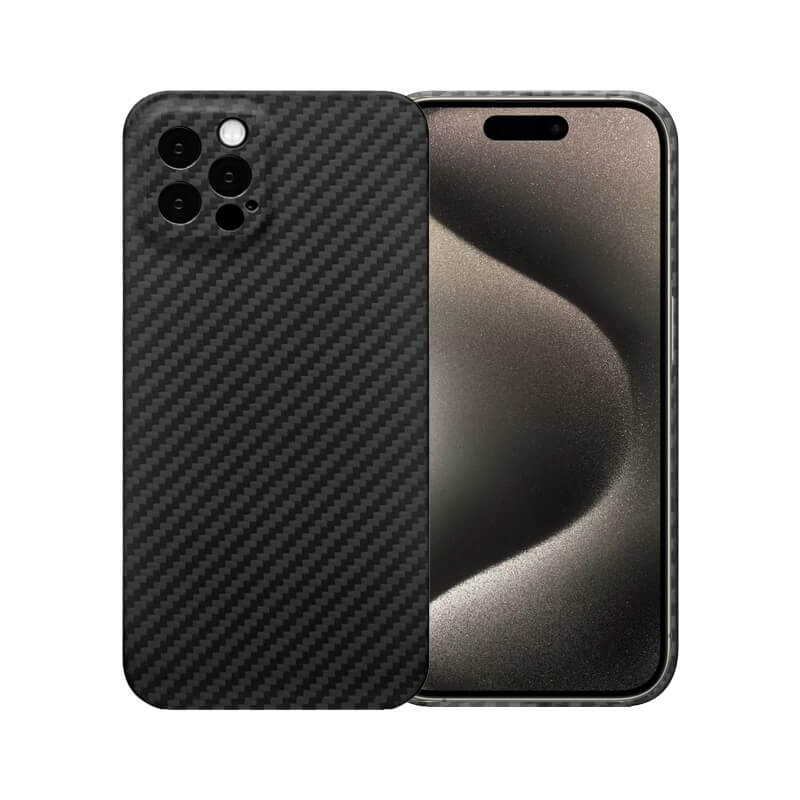
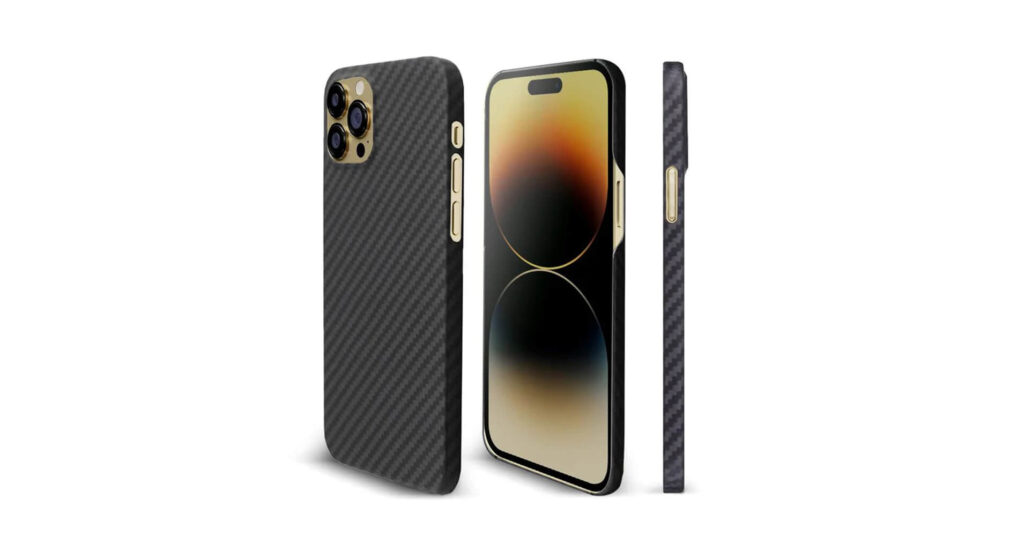
A premium, lightweight, and performance-inspired look.
Slim design, protects your iPhone without adding unnecessary bulk.
Built-in MagSafe magnets support convenient charging and accessories.
Precision fit provides easy access to buttons, ports, and cameras.
Raised edges help protect your screen and camera lenses from scratches.
Designed specifically for the iPhone 15 Pro for a precise fit.
Carbon Fiber vs. Aramid Fiber vs. Carbon-Look Cases
Another source of confusion is the term “carbon fiber case.”
Not every product marketed with a carbon-fiber appearance is made from the same material.
| Material | Electrical behavior | Wireless charging considerations |
|---|---|---|
| Genuine carbon fiber | Conductive | Construction and placement matter |
| Aramid fiber | Generally electrically insulating | Usually easier to integrate around charging systems |
| Carbon-look plastic | Generally insulating | Usually little material-related interference |
| Metal | Highly conductive | Can interfere with wireless charging |
| Hybrid composite | Depends on construction | Must be evaluated as a complete system |
Genuine carbon fiber has electrical properties that are useful in engineering applications, including EMI shielding. Scientific studies have demonstrated that the electrical and shielding properties of carbon-fiber composites depend on factors such as fiber volume, orientation and laminate structure.
That is why you should not judge a phone case simply by its surface appearance.
Can You Use a MagSafe Charger with a Carbon Fiber Case?
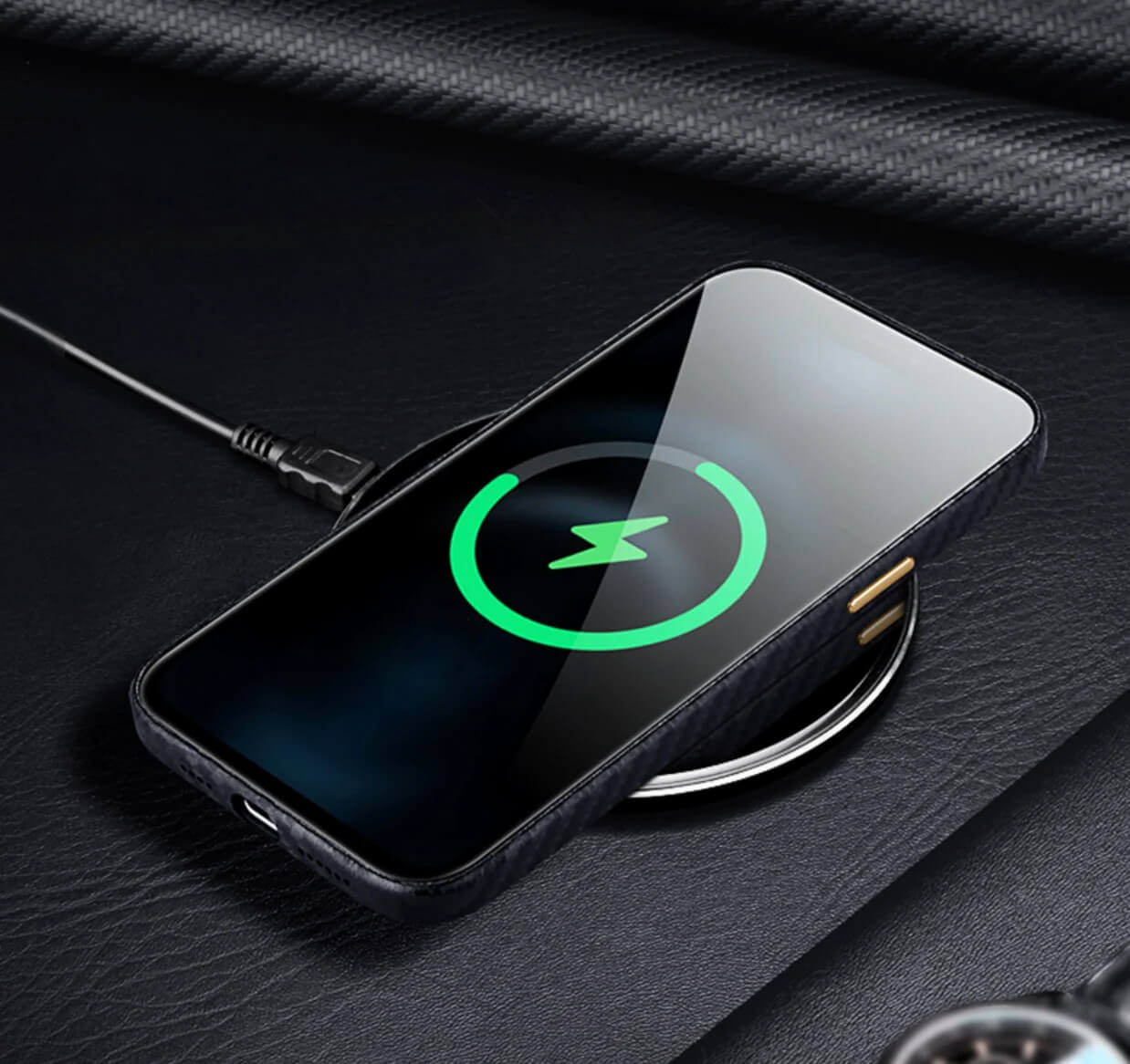
If the case is specifically designed for MagSafe, you should be able to use a compatible MagSafe charger without removing it.
Apple’s current MagSafe Charger is certified for Qi2 25W and Qi charging. Apple lists wireless charging support across a broad range of iPhone generations, while the magnetic-alignment experience applies to compatible MagSafe iPhone models.
There are therefore two separate questions:
Does it charge?
and
Does the MagSafe magnet attach and align correctly?
A case can potentially allow wireless power transfer while providing a weak or poorly positioned magnetic connection. A properly engineered MagSafe case should address both requirements.
What About Qi2 Wireless Charging?
Qi2 is important because modern magnetic wireless charging is no longer limited to Apple’s proprietary ecosystem.
The Wireless Power Consortium developed Qi2 as a newer generation of the Qi wireless-charging standard, with magnetic alignment playing an important role in the newer system.
Apple’s current MagSafe Charger is officially listed as certified for Qi2 25W and Qi charging.
For consumers, the practical lesson is simple:
When buying a carbon fiber case, don’t look only for the word “wireless charging.”
If you regularly use magnetic chargers or accessories, also look for clear compatibility information for MagSafe and/or Qi2, depending on your phone and charger.
Will a Carbon Fiber MagSafe Case Make Wireless Charging Slower?
It can, but the case is not necessarily the reason.
Wireless charging performance depends on several variables:
- Case thickness
- Coil alignment
- Charger design
- Charging protocol
- Phone temperature
- Power adapter
- Phone model
- Conductive materials near the charging system
Apple notes that an iPhone can become warmer during wireless charging. If the phone becomes too warm, software may temporarily limit charging above 80 percent until its temperature falls.
Therefore, slower charging does not automatically mean that the carbon fiber material is the problem.
A useful test is to compare:
Phone without case → same charger → phone with case
If charging behavior changes substantially, the case deserves investigation.
Why Won’t My iPhone Charge Through My Carbon Fiber Case?
If charging does not work, check these factors one by one.
The case may be too thick
Remove the case and test the phone directly on the charger.
If charging immediately works normally, case thickness or construction may be involved.
The magnetic alignment may be incorrect
A MagSafe charger should attach around the intended magnetic ring.
If it attaches off-center or feels unusually weak, the magnetic system may not be positioned correctly.
The case may contain metal
Check for metal plates, decorative metal pieces, metal rings or other conductive components.
These can interact with the wireless-charging field.
The phone may be too hot
Wireless charging naturally produces some heat. Excessive temperature can cause the phone to reduce or temporarily stop charging.
There may be something between the phone and charger
Apple specifically warns about objects between the iPhone and charger and recommends removing sensitive cards or similar items from cases before charging.
The charger may be the problem
Test the case with another known-compatible Qi, Qi2 or MagSafe charger.
This simple test can separate a case problem from a charger problem.
How to Test a Carbon Fiber Case for Wireless Charging
You don’t need laboratory equipment to perform a useful consumer test.
Try this sequence:
- Charge the phone without the case.
- Note whether charging starts normally.
- Put the carbon fiber case on the phone.
- Place the phone on the same charger.
- Check whether charging begins.
- Check whether the MagSafe connection is centered.
- Compare charging behavior and temperature.
- Repeat the test with another compatible charger if necessary.
For a more serious engineering evaluation, charging power, temperature, coil alignment and charging time can be measured under controlled conditions.
That is much more meaningful than simply saying that a case is “wireless charging compatible.”
How to Choose a Carbon Fiber MagSafe Case for Wireless Charging
If wireless charging is important to you, look for these characteristics:
1. Explicit MagSafe compatibility
The manufacturer should clearly state that the case supports MagSafe.
2. Wireless-charging compatibility
Look for specific information rather than a vague “phone-friendly” claim.
3. Proper magnetic-ring integration
The ring should be designed for the exact phone model.
4. Slim construction
A thinner case generally creates less distance between the charging coils.
5. Minimal unnecessary metal
Be cautious about cases containing metal components near the charging area.
6. Precise phone-specific design
The position of the camera, charging coil and magnetic system varies between phone models.
7. Actual testing
Manufacturer testing is more valuable than simply showing a picture of a MagSafe charger attached to a case.
Carbon Fiber MagSafe Case vs. Regular Carbon Fiber Case
The two should not be considered identical.
A conventional carbon fiber case may focus primarily on lightweight protection and appearance.
A carbon fiber MagSafe case has an additional engineering requirement: it must integrate the magnetic attachment system while maintaining compatibility with wireless power transfer.
That means the designer has to think about:
structure + material + thickness + magnetic alignment + charging performance
rather than simply making a carbon fiber shell.
Frequently Asked Questions
Does real carbon fiber block wireless charging?
Not necessarily. Real carbon fiber is electrically conductive, so its effect depends on the case’s construction, thickness, fiber arrangement and other materials. Research confirms that carbon-fiber composites can interact with electromagnetic fields, but this does not mean every carbon fiber case will prevent wireless charging.
Can you use MagSafe through a carbon fiber case?
Yes, when the case is specifically designed with a properly positioned magnetic system and compatible construction.
Can a carbon fiber case work with a Qi charger?
Yes, a properly designed case can work with Qi wireless charging. However, performance can vary depending on the case and charger.
Can carbon fiber interfere with MagSafe?
Carbon fiber’s electrical conductivity means the material should be considered during case design. The complete case structure—not the material name alone—determines the practical result.
Should I remove my carbon fiber case before wireless charging?
Not if the case is specifically designed and tested for wireless charging. If charging is slow, intermittent or fails, remove the case and test the phone directly on the charger. Apple recommends this approach for thick or metal cases that interfere with charging.
Final Takeaway
So, do carbon fiber MagSafe phone cases work with wireless charging?
Yes, they can—and a properly engineered case should.
But the important lesson from a materials-engineering perspective is that “carbon fiber” is not enough information to predict wireless-charging performance.
Carbon fiber is electrically conductive, and scientific research shows that carbon-fiber composites can interact with electromagnetic fields and provide EMI-shielding effects.
At the same time, a phone case is a carefully designed composite system. Its thickness, fiber arrangement, resin, magnetic ring, internal materials and other components all affect how the case behaves around a wireless charger.
For consumers, the simplest rule is:
Choose a carbon fiber case that is specifically engineered for MagSafe and wireless charging—not simply a case that happens to be made from carbon fiber.
When those requirements are properly addressed, you can enjoy the combination of carbon fiber’s lightweight strength and distinctive appearance while continuing to use the convenience of magnetic and wireless charging.