Choosing a phone case often looks simple. You see a case you like, check whether it fits your phone, and buy it. But the material of the case can make a major difference in its weight, grip, durability, appearance, and ability to protect your phone. So, what is the best phone case material?
There is no single material that is best for everyone. TPU, silicone, polycarbonate, leather, aramid fiber, carbon fiber, and hybrid constructions all have different strengths. The right choice depends on what you expect from your case.
As a materials engineer, I would also make one important point: the material name alone does not determine how protective a phone case is. Thickness, geometry, corner design, fit, internal cushioning, surface texture, and the way different materials are combined can be equally important.
This guide explains the most common phone case materials, what they actually do, and how to choose the right one for your needs.
What Makes a Good Phone Case Material?
Before comparing individual materials, it helps to understand what we actually want from a phone case.
A good case may need to provide several different properties:
- Impact protection
- Appropriate stiffness and flexibility
- Low weight
- Good grip
- Scratch and abrasion resistance
- Long-term dimensional stability
- Resistance to heat, moisture, and everyday wear
- Compatibility with wireless charging and magnetic accessories
- A comfortable appearance and feel
These requirements can conflict with one another.
For example, a very soft material may provide excellent grip and flexibility but lack the stiffness needed for a thin structural shell. A very rigid material can provide excellent structural support but may need another material to improve impact management.
This is why many high-performance cases use more than one material.
The current phone-case market reflects this approach: TPU, silicone, polycarbonate, aramid fiber, and other materials are often used either individually or in combination.
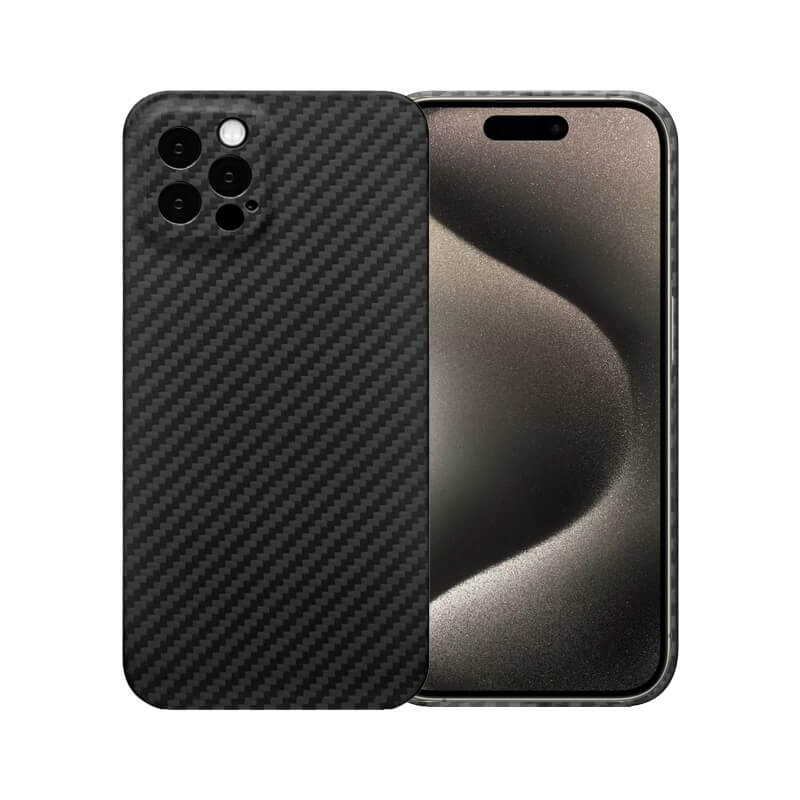
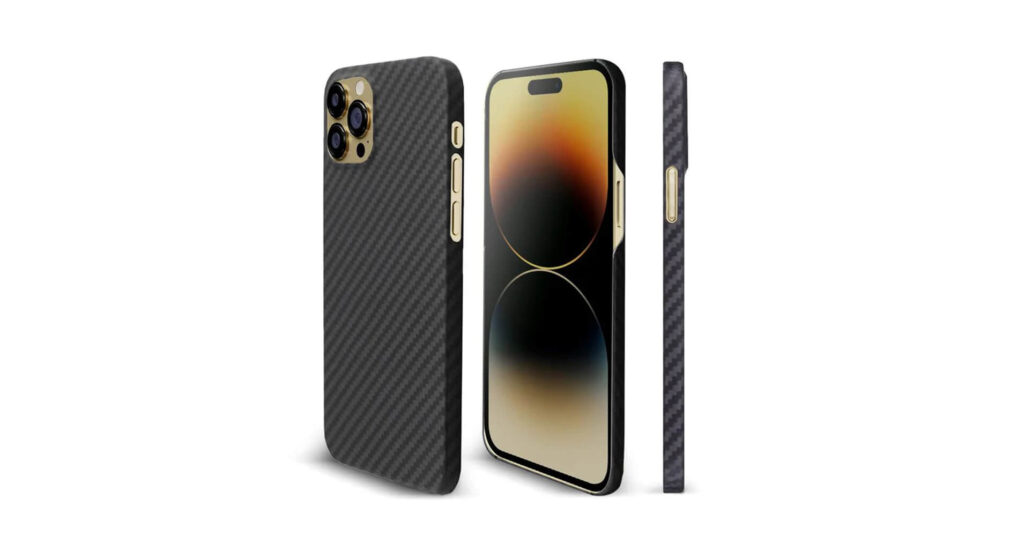
A premium, lightweight, and performance-inspired look.
Slim design, protects your iPhone without adding unnecessary bulk.
Built-in MagSafe magnets support convenient charging and accessories.
Precision fit provides easy access to buttons, ports, and cameras.
Raised edges help protect your screen and camera lenses from scratches.
Designed specifically for the iPhone 15 Pro for a precise fit.

Quick View: Which Phone Case Material Is Best?
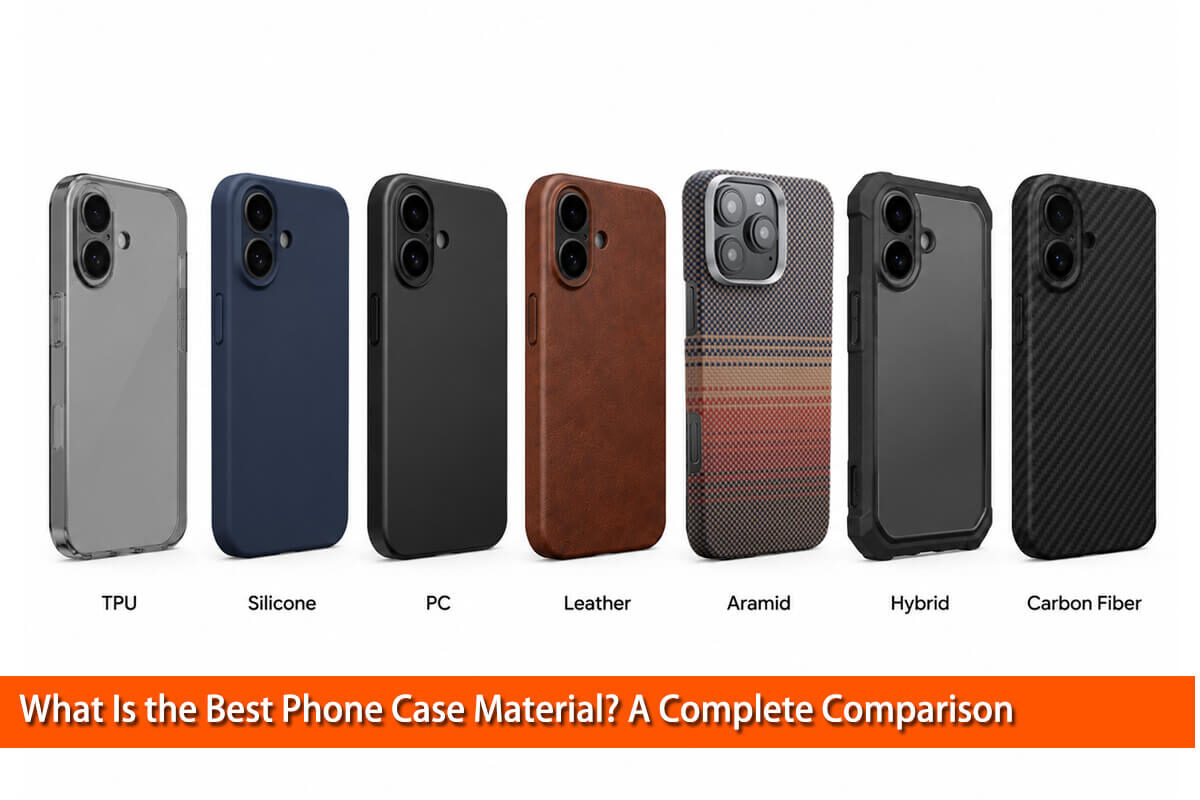
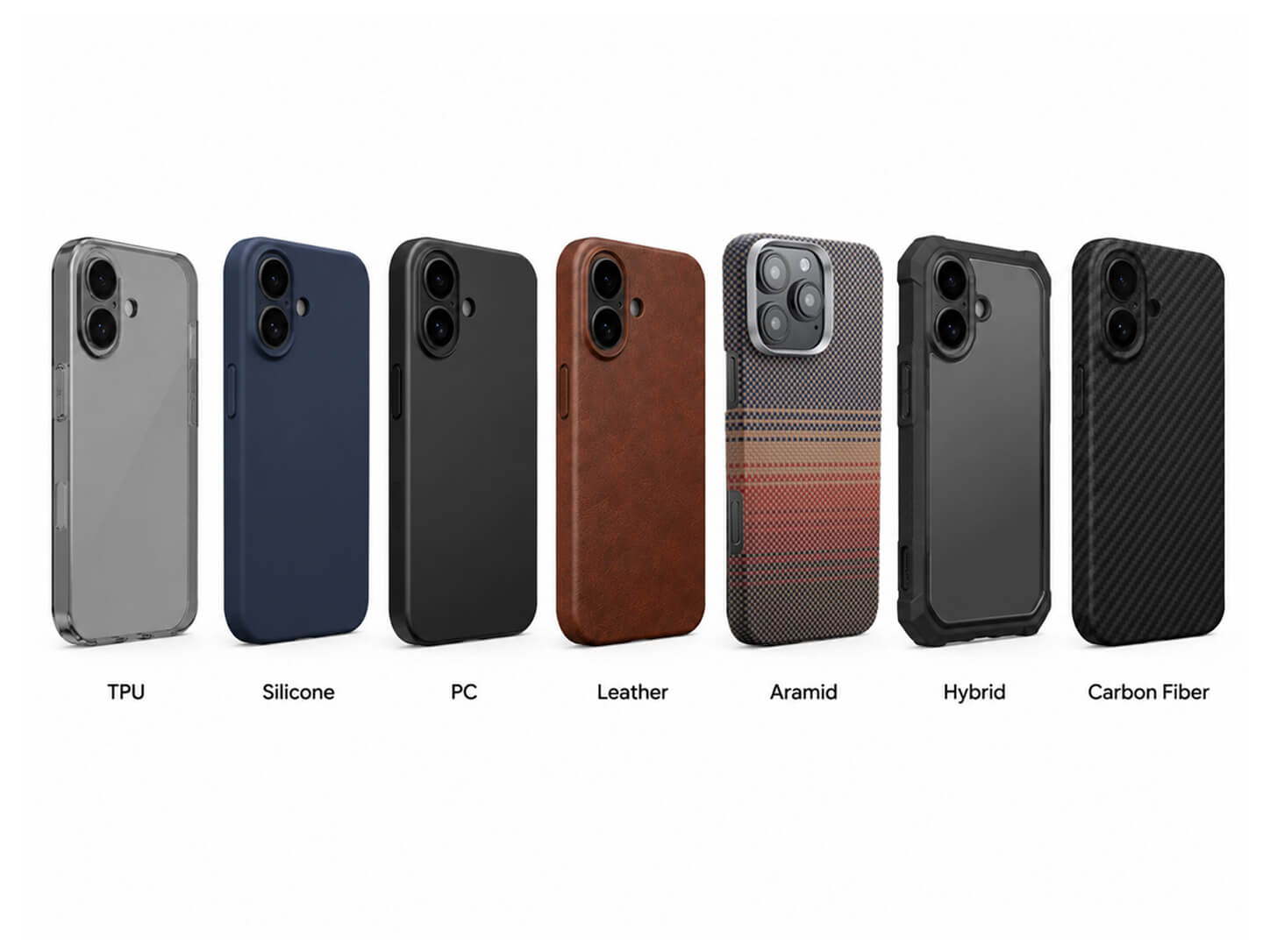
Here is a simple summary table, comparing the strength, weakness and advantages of different materials:
| Materials | Main Strength | Main Weakness | Best For |
|---|---|---|---|
| TPU | Flexibility and impact absorption | Can age/yellow | Everyday protection |
| Silicone | Grip and soft feel | Can attract lint/dust | Grip-focused users |
| Polycarbonate | Rigidity and scratch resistance | Less shock absorption alone | Hard-shell cases |
| Leather | Premium feel and appearance | Water/wear sensitivity | Luxury style |
| Aramid Fiber | Very thin and lightweight | Higher price | Slim premium cases |
| Carbon Fiber | High stiffness-to-weight potential | Usually more expensive | Lightweight premium cases |
| Hybrid | Combines different properties | More complex construction | Maximum versatility |
Actually, no material is the universal winner.
The best phone case material is the one whose properties match the way you use your phone.
1. TPU: A Practical Choice for Everyday Protection
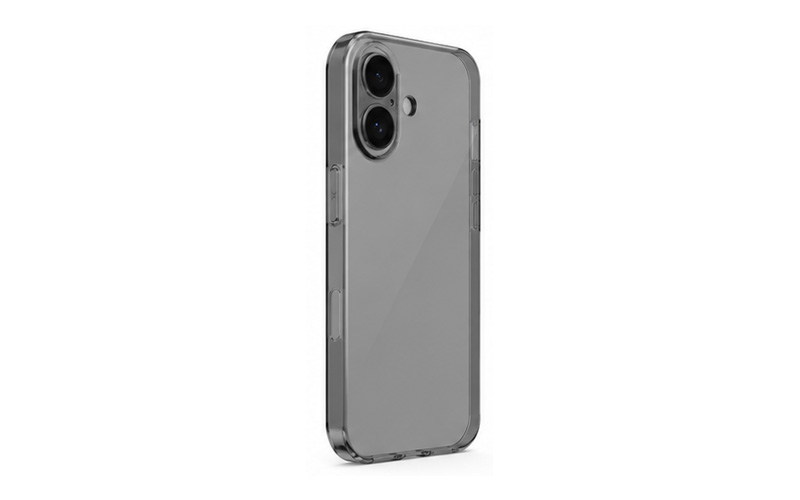
TPU stands for thermoplastic polyurethane. It is a flexible thermoplastic widely used in phone cases, especially around the edges and corners.
TPU is popular because it offers a useful balance between flexibility, toughness, grip, weight, and cost.
Advantages of TPU
- Flexible and easy to install
- Good resistance to everyday impacts
- Relatively lightweight
- Comfortable to hold
- Useful for bumpers and protective edges
- Generally affordable
One of TPU’s important advantages is that it can deform under load rather than behaving like a completely rigid shell. This makes it useful when designers want a degree of cushioning around the phone.
However, TPU is not one universal material with identical performance. Different formulations can have different hardness, elasticity, abrasion resistance, and aging behavior.
Some transparent TPU cases can also become yellow or change appearance over time, particularly depending on formulation and exposure to UV light.
Best for: everyday users who want a flexible, practical, and affordable case.
A related reading: Is Carbon Fiber Better Than TPU?
2. Silicone: Excellent Grip and a Soft Feel
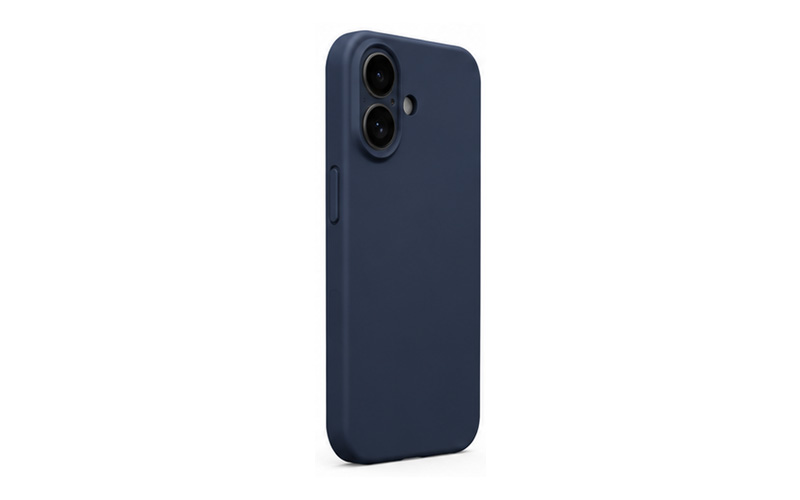
Silicone is an elastomer with a noticeably soft and smooth feel. It is often selected for phone cases because it feels comfortable in the hand and can provide excellent grip.
A silicone case can be particularly attractive to people who frequently hold their phone with one hand.
Advantages of silicone
- Excellent grip
- Soft-touch surface
- Comfortable in the hand
- Flexible
- Premium tactile feel
- Good everyday usability
There are also trade-offs.
Soft silicone surfaces can collect lint and dust, and surface wear can eventually affect their appearance. More importantly, softness alone should not be confused with complete impact protection.
A silicone surface may feel protective, but the actual protection of the phone also depends on the case’s internal structure, corners, thickness, and fit.
Best for: people who prioritize grip and a soft, comfortable feel.
Learn more: Is Carbon Fiber Stronger Than Silicone?
3. Polycarbonate: Rigid and Lightweight
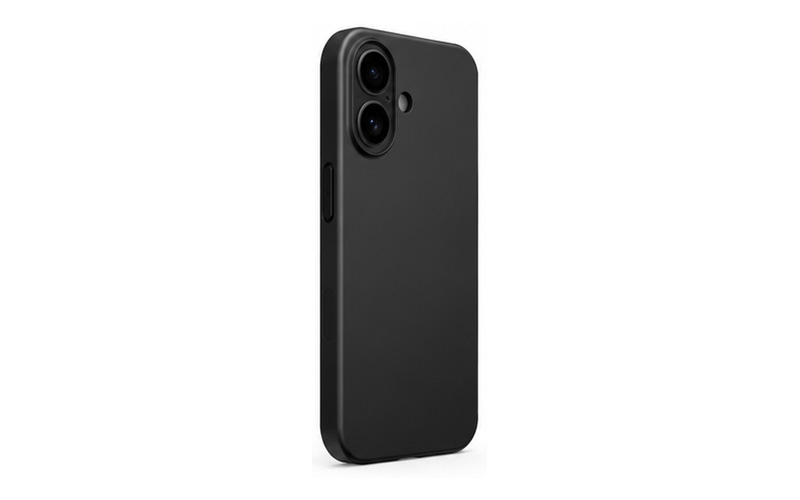
Polycarbonate, commonly called PC, is a rigid thermoplastic widely used for hard-shell products.
Compared with TPU and silicone, PC provides considerably more structural rigidity.
This makes it useful for:
- Rigid back panels
- Structural shells
- Reinforced areas
- Thin hard cases
- Hybrid case construction
A rigid material can help distribute loads across a larger area rather than allowing a localized force to remain concentrated at one point.
However, a rigid shell does not automatically mean maximum drop protection. PC is often more effective when combined with a softer material that can provide additional impact management.
This is one reason hybrid cases are so common.
Best for: users who prefer a rigid, structured case and designers who need a hard outer shell.
4. Leather: Premium Feel Rather Than Pure Engineering Performance
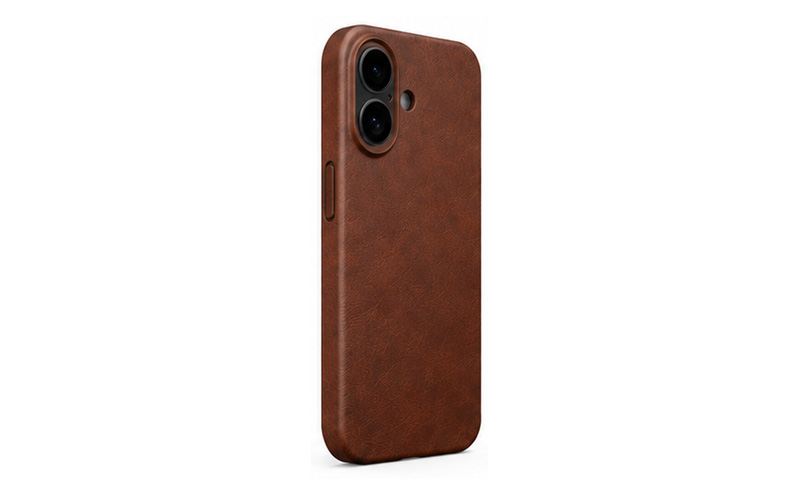
Leather occupies a different position from engineering plastics and fiber composites.
Its main advantages are often related to feel, appearance, and aging characteristics rather than maximum strength-to-weight performance.
High-quality leather can develop a distinctive surface over time, which appeals to users who prefer traditional luxury materials.
However, leather can be sensitive to moisture, scratches, oils, and general wear. It also normally forms only part of a complete protective case rather than acting as the sole structural material.
Therefore, when evaluating a leather case, look beyond the outer material. The internal frame, shell, padding, and corner construction can have a much greater effect on protection.
Best for: users who prioritize premium appearance, texture, and traditional materials.
5. Aramid Fiber: Thin and Lightweight
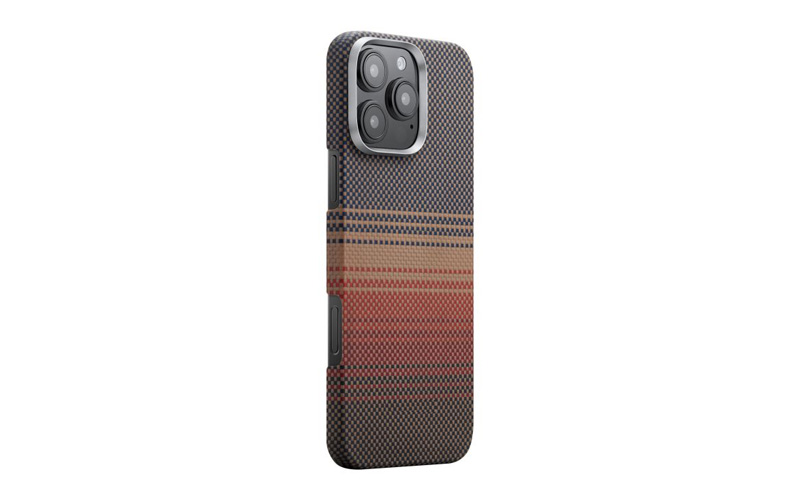
Aramid fiber is a high-performance synthetic fiber used in demanding engineering applications. Kevlar is one well-known example of a para-aramid fiber.
One reason aramid fiber attracts attention in premium phone cases is its high strength-to-weight ratio.
DuPont’s technical information on Kevlar describes the material as lightweight while providing high strength-to-weight performance and resistance to abrasion and other forms of damage.
In a phone case, aramid fiber can be formed into a thin composite shell with a distinctive woven appearance.
Advantages
- Very lightweight
- Can be made extremely thin
- High strength-to-weight characteristics
- Premium appearance
- Good dimensional stability
The trade-off is cost. High-quality fiber composites require more specialized materials and manufacturing processes than ordinary plastic cases.
Also, aramid fiber should not be treated as a magic material. The final performance depends on fiber type, orientation, resin system, thickness, bonding, and case geometry.
Best for: users who want a very thin, lightweight, premium case.
You may also interested in: Carbon Fiber vs Aramid Phone Cases: The Ultimate Comparison
6. Carbon Fiber: High Stiffness with Low Weight
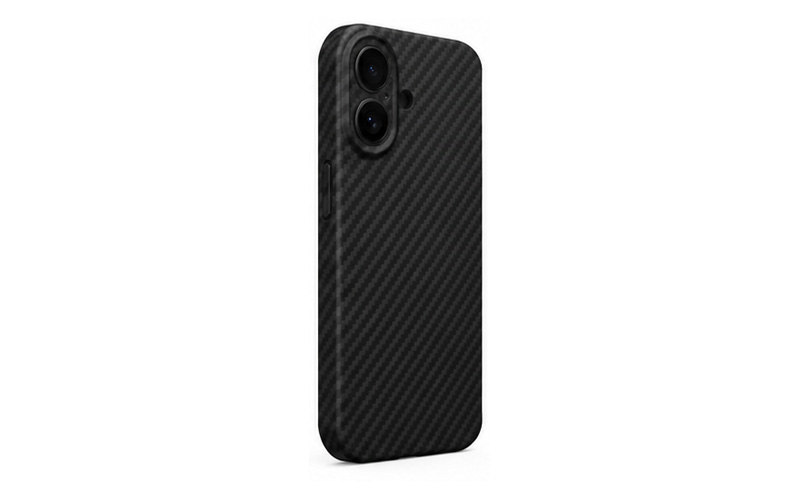
Carbon fiber is another advanced reinforcement material used in high-performance composites.
It is important to understand what carbon fiber actually is.
A carbon-fiber product is normally a composite, meaning carbon fibers are combined with a polymer matrix. The fibers provide much of the structural reinforcement, while the matrix holds the fibers together and transfers loads between them.
The performance of carbon-fiber composites can be impressive. UC Berkeley’s Mechanical Engineering department notes that carbon, aramid, and glass fiber composites offer exceptionally high strength- and stiffness-to-weight ratios among engineering materials. It also notes that carbon-fiber composites can provide very high stiffness at much lower weight than steel in comparable structural applications.
This combination is particularly interesting for a carbon fiber phone case.
A well-designed carbon-fiber case can provide a thin, rigid structure without adding the weight associated with many bulkier protective materials.
Advantages of carbon fiber
- High stiffness-to-weight potential
- Low weight
- Thin construction potential
- Distinctive woven appearance
- Premium engineering material
- Excellent dimensional stability in appropriate composite designs
But there is an important limitation.
Carbon fiber does not automatically mean an indestructible phone case.
Carbon fiber composites can be very stiff, but impact protection is more complicated than simply maximizing stiffness. Fiber direction, laminate design, resin properties, thickness, edges, corners, and the way the case interacts with the phone all matter.
For this reason, a premium carbon fiber phone case should be evaluated as a complete product rather than simply by asking how much carbon fiber it contains.
Best for: users who want a lightweight, thin, rigid, and premium case.
7. Hybrid Cases: Why Combining Materials Often Makes Sense
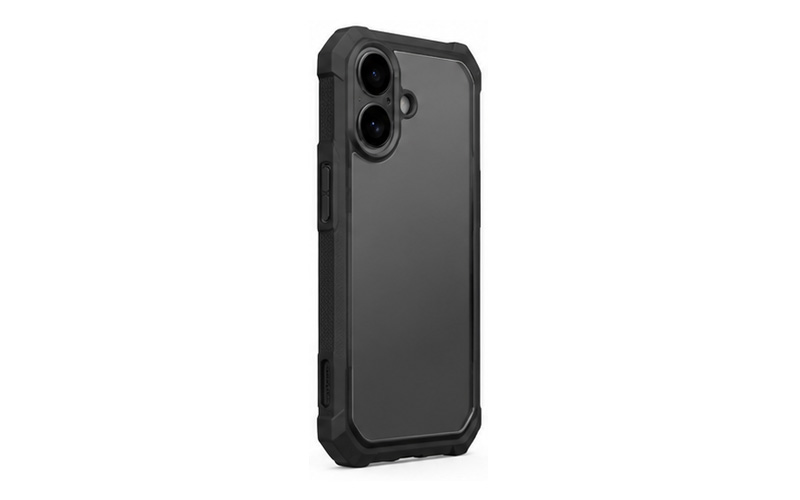
If I had to identify one important principle in phone-case engineering, it would be this:
Different materials can solve different problems.
For example, a case might use:
TPU + polycarbonate
The TPU can provide flexibility and cushioning, while the PC shell provides rigidity and structural support.
Other designs may combine:
- Soft inner liners with rigid shells
- Fiber composites with polymer frames
- Reinforced corners with flexible sidewalls
- Hard backs with softer edges
This is not simply a marketing trick. It is a logical engineering approach because materials have different mechanical properties.
A phone case is a system, not just a piece of material.
8. Which Material Is Best for Drop Protection?
This is where consumers should be careful with simple marketing claims.
There is no universal rule that says “the hardest material provides the best drop protection.”
During a drop, the phone experiences a sudden change in momentum. The case must manage the resulting impact energy and prevent excessive forces from reaching vulnerable components.
Case geometry matters enormously.
Important design features include:
- Reinforced corners
- Raised screen edges
- Raised camera edges
- Appropriate wall thickness
- Internal cushioning
- Good phone-to-case fit
- Controlled deformation
- Multi-material construction
ASTM International’s D5276 standard describes a free-fall drop test method and explains that controlled drop testing can be used to evaluate and compare protective performance under defined conditions.
This is an important lesson for consumers: when a manufacturer says a case has been “drop tested,” ask how it was tested.
Drop height, surface, number of drops, phone model, orientation, and pass/fail criteria all matter.
9. What About MagSafe and Wireless Charging?
Material selection can also affect how a case works with wireless charging and magnetic accessories.
However, the material itself is only part of the equation.
For a MagSafe-compatible case, factors such as:
- Magnet position
- Magnet strength
- Case thickness
- Alignment
- Internal construction
- Material around the charging area
can all affect performance.
Therefore, don’t assume that every case made from the same material will have the same wireless-charging performance.
If you use MagSafe every day, look for a case specifically designed and tested for the magnetic system rather than choosing purely based on material.
Comprehensive Phone Case Material Comparison
| Property | TPU | Silicone | PC | Leather | Aramid | Carbon Fiber | Hybrid |
|---|---|---|---|---|---|---|---|
| Flexibility | High | High | Low | Medium | Low | Low | Medium–High |
| Weight | Low | Low | Low | Medium | Very Low | Very Low | Medium |
| Grip | Good | Excellent | Medium | Good | Medium | Medium | Good |
| Rigidity | Medium | Low | High | Low–Medium | High | High | High |
| Scratch Resistance | Medium | Low–Medium | High | Low | High | High | High |
| Thickness Potential | Medium | Medium | Thin | Medium | Very Thin | Very Thin | Medium |
| Premium Feel | Medium | High | Medium | Very High | Very High | Very High | High |
| Typical Cost | Low | Medium | Low–Medium | High | High | High | Medium–High |
Important: These are general tendencies, not universal laboratory measurements. Exact performance varies substantially by formulation and construction.
10. How Should You Choose Your Phone Case Material?
The easiest approach is to start with your priorities.
If you want everyday practicality
TPU is a sensible choice because it provides flexibility, grip, and affordability.
If grip is your top priority
Silicone is attractive because of its soft and grippy surface.
If you want a rigid shell
Polycarbonate is a practical option.
If you want a traditional luxury appearance
Leather offers a distinctive tactile experience.
If you want an ultra-thin case
Aramid fiber and carbon-fiber composites are worth considering.
If you want lightweight premium construction
A well-designed carbon fiber phone case or aramid-fiber case can be especially interesting because of the high stiffness-to-weight potential of fiber-reinforced composites.
If you want balanced protection
A hybrid case combining complementary materials may make more sense than choosing one material alone.
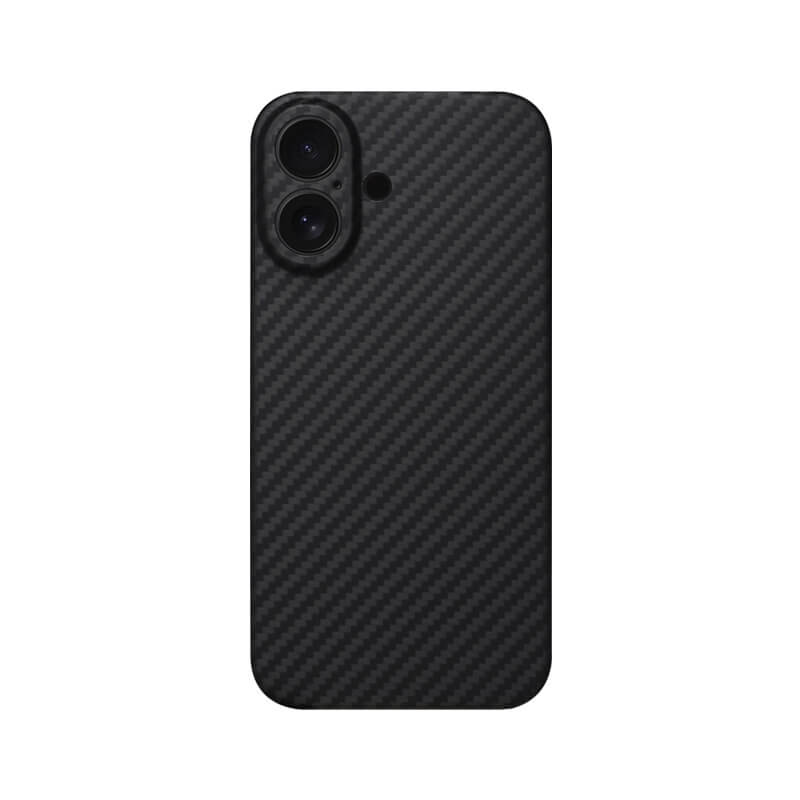
Strong MagSafe magnets ensure secure attachment.
Slim profile protects without adding unnecessary bulk.
Raised edges protect screen and camera.
Textured surface provides a secure grip.
Precise cutouts ensure easy everyday access.
Durable construction helps absorb everyday impacts.
Supports wireless charging without removing the case.
Final Answer: What Is the Best Phone Case Material?
So, what is the best phone case material?
The honest engineering answer is: it depends on what you need.
TPU is practical and flexible. Silicone provides excellent grip and a soft feel. Polycarbonate provides rigidity. Leather emphasizes appearance and tactile quality. Aramid fiber is attractive for very thin and lightweight designs. Carbon fiber offers an excellent combination of low weight and high stiffness potential. Hybrid cases can combine several of these properties.
The most important lesson is that material name is only the beginning.
When choosing a phone case, consider the entire construction: material, thickness, fiber orientation where applicable, corner design, raised edges, internal cushioning, fit, surface finish, and compatibility with accessories.
For someone who wants a slim, lightweight, premium case, carbon fiber is particularly interesting because it brings advanced composite-material technology into an everyday product. But it should be selected because the complete case is well engineered, not simply because the words “carbon fiber” appear on the package.
In the end, the best phone case is not necessarily the hardest, thickest, or most expensive one. It is the case whose material and construction match the way you actually use your phone.
References:
DuPont technical information on Kevlar